Integrated Software Ecosystem for Packaging
Automate design processes, optimize logistics, and precisely quote production with our dedicated B2B tools.
Our B2B Solutions
CalcPack
CalcPack is a professional environment and B2B platform designed for the instant and highly precise pricing of cardboard packaging. The application automates the complex quoting process, enabling packaging manufacturers and distributors to generate accurate cost calculations in real time.Key features of the system:Instant Quoting: Rapid generation of price offers based on specific parameters such as dimensions, box style (e.g., FEFCO standards), cardboard grade, and printing options.High Precision Calculations: Advanced algorithms accurately factor in raw material costs, production processes, markups, and margins, completely eliminating the risk of human error in pricing.Sales Workflow Optimization: The tool significantly reduces the turnaround time for customer inquiries, enhancing the efficiency and professionalism of the sales department.
Learn morePaletyzer
Paletyzer is an advanced analytical and logistics tool designed to maximize the efficiency of transportation and warehousing. The application automates the process of planning product layouts on pallets and precisely calculates packaging strength, ensuring the absolute safety of the entire cargo load.Key features of the system:Advanced Spatial Optimization: The algorithm generates the most efficient stacking patterns for boxes on a pallet, maximizing volume utilization and significantly reducing shipping costs.BCT (Box Compression Test) Calculation: The system dynamically calculates the static crush resistance of corrugated boxes stacked on top of each other. This ensures that the bottom layers of the load will not collapse under the weight of the upper tiers.Cargo Safety and Stability: Through precise calculations of physical parameters and optimal weight distribution, the application drastically minimizes the risk of product damage during transit and storage.
Learn moreDielineo
Dielineo is an industry-specific CAD program developed exclusively for drawing and generating packaging dielines. Positioned as a modern and highly capable alternative to expensive, market-leading CAD systems, it provides packaging engineers and designers with a comprehensive and tailored workspace.Key features of the system:Precision CAD Design: A suite of intuitive drafting tools dedicated strictly to the packaging industry, allowing for the creation and parametric generation of complex cardboard dielines.Macro-Driven Automation: An advanced macro-building system enables users to automate repetitive design workflows and structural modifications, significantly speeding up the development of new packaging.Interactive 3D Visualization: A built-in 3D module allows the 2D dieline to be instantly folded into a spatial model. This facilitates immediate structural verification, early error detection prior to physical prototyping, and professional project presentation to clients.
Learn moreLogiPack
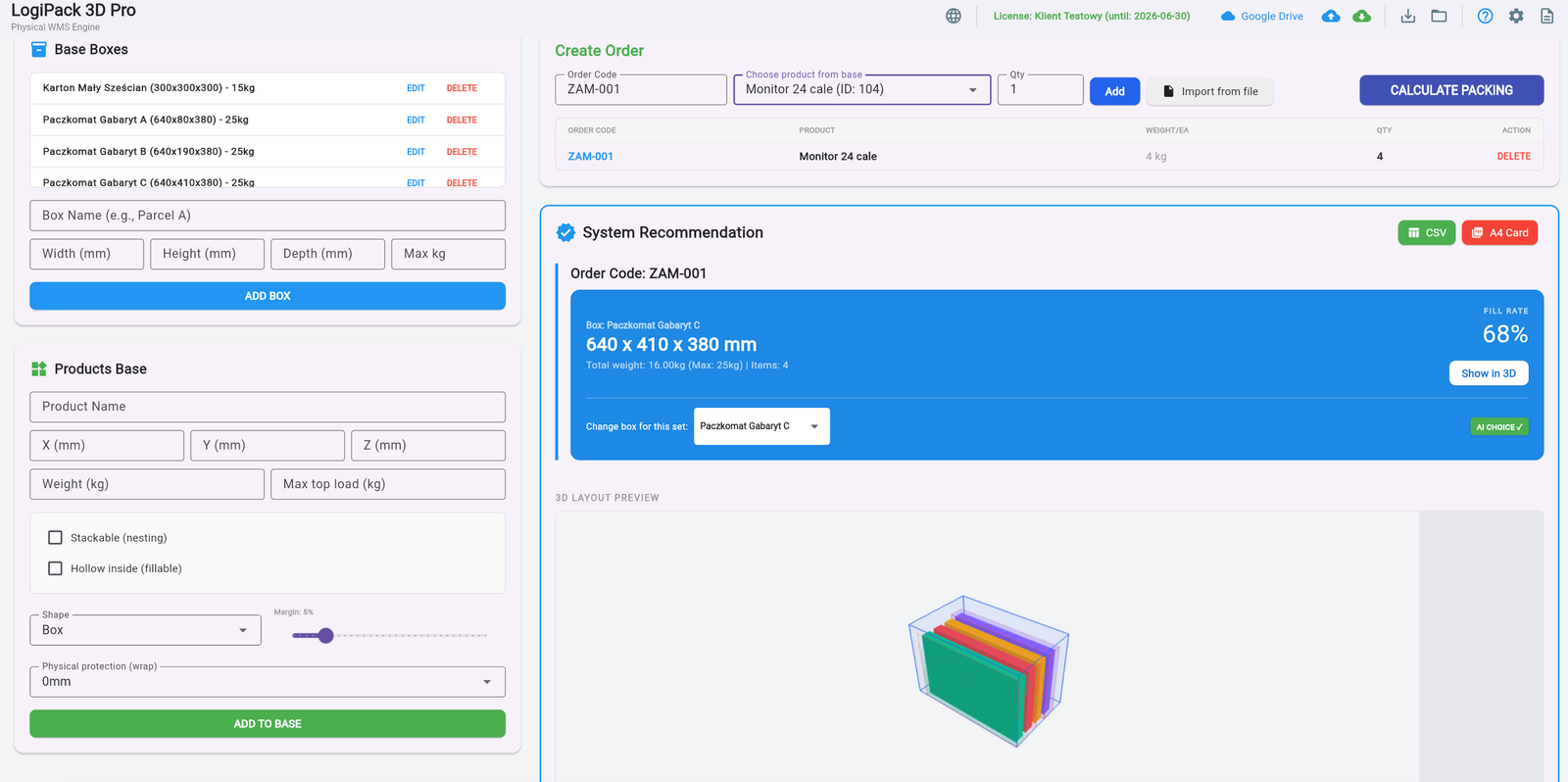
Logipack is a logistics application designed to automate and optimize the order packing process. The software analyzes the dimensions of all items within a single customer order and matches them against a predefined set of available boxes (approximately 10 standard sizes).Key features of the system:Smart Box Selection: The algorithm accurately identifies the specific box size required for each order.Spatial Optimization: The application suggests the most efficient spatial arrangement of products inside the carton to maximize the use of available space.Time and Cost Efficiency: By eliminating the trial-and-error approach to packing, the solution minimizes the need for void fill materials and reduces overall shipping costs through better volume utilization.
Learn moreSlicer 3D
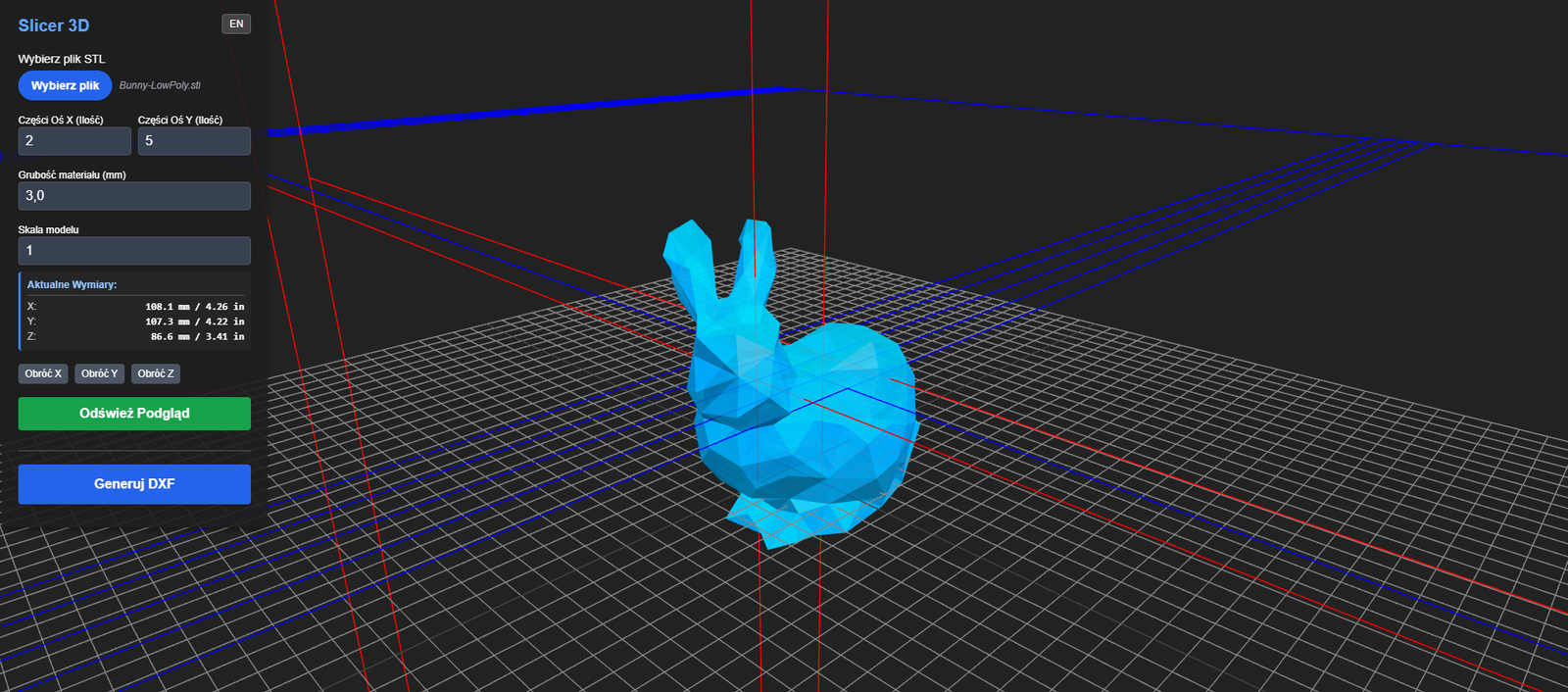
3D Slicer by KUMIBOX is a free, fully browser-based tool that enables the instant conversion of any 3D models (STL files) into physical, cardboard spatial structures (waffle structures). The application automates the complex process of designing interlocking planes, eliminating the need for costly and time-consuming manual slot drafting in CAD systems.Key features of the system:From 3D Solid to Flat Grid: Within seconds, the algorithm analyzes the volume of the solid and generates precise cutting paths for horizontal (X) and vertical (Y) slices.Full Parameterization: The user has complete control over grid density (detail resolution), model scale, and material thickness. The system precisely adjusts slot widths, allowing for the creation of stable, friction-fit structures without the use of glue.Production Ready (DXF Export): The tool generates clean DXF vector files, optimized for cutting plotters (e.g., Kongsberg, Zünd) and laser cutters. The generated layouts can be directly imported into the Dielineo system for seamless editing and integration with other packaging designs.
Learn morePallet Layout Wizard
The Pallet Layout Wizard by KUMIBOX is a free, intuitive online tool designed for the instant optimization of cargo space. The application automates the load planning process for trucks, vans, and sea containers, effectively eliminating costly guesswork and trial-and-error in logistics.Key features of the system:Instant Load Visualization: In just a few seconds, the algorithm generates a precise, visual loading plan, maximizing the utilization of available vehicle volume (with no registration or complex setup required).Mixed Pallet Standard Support: The system allows for the flexible combination of various pallet types and sizes (e.g., EU, US, and Industrial standards) within a single cargo space (vans, trucks, 20ft and 40ft containers).Practical Process Optimization: The tool goes beyond mere volume filling; it assists in organizing multi-stop unloading sequences and helps prevent axle overloading, leading to tangible reductions in overall transportation costs.
Learn moreLatest Updates
Logipack: 3D Bin Packing Software to Master EU PPWR Regulations ▼
Hi! This is KUMIBOX. E-commerce logistics is changing. Shipping “air” in oversized boxes is no longer just a financial loss—it will soon be a regulatory violation. Today, we are diving into smart packaging optimization. Logipack: 3D Bin Packing Software to Master EU PPWR Regulations The EU’s Packaging and Packaging Waste Regulation (PPWR) is just around […]
Hi! This is KUMIBOX.
E-commerce logistics is changing. Shipping “air” in oversized boxes is no longer just a financial loss—it will soon be a regulatory violation. Today, we are diving into smart packaging optimization.
Logipack: 3D Bin Packing Software to Master EU PPWR Regulations
The EU’s Packaging and Packaging Waste Regulation (PPWR) is just around the corner, demanding strict limits on empty space ratio in e-commerce shipments. If your warehouse still relies on guesswork to pick shipping boxes, you risk compliance penalties and wasted resources.
That is why we built Logipack. It is an automated software solution designed to select the absolute best box for multi-item orders and streamline your dispatch process.

1. How Logipack Optimizes Your Warehouse
Imagine your company restricts its inventory to just 5 standard box sizes to save on procurement. When a customer orders a complex mix of products, finding the smallest possible box that fits everything is a geometric puzzle.
How it works: The system analyzes the volume and dimensions of the ordered goods. It instantly evaluates your predefined list of boxes and selects the one that maximizes fill rate. To complete the workflow, Logipack automatically generates the shipping labels.
2. Advanced Product Nesting
Real-world products aren’t always perfect cubes. We engineered Logipack to understand complex geometries, which is crucial for maximizing space.
- Smart Nesting: The algorithm recognizes when items can be stacked inside one another (like flower pots, buckets, or cones).
- Space Maximization: By calculating the nested dimensions, Logipack prevents unnecessary upgrades to larger boxes.
- Reduced Fillers: A tighter fit means less need for bubble wrap, void fill, or structural supports.
3. Ready for the PPWR Era
The upcoming PPWR mandates a maximum empty space ratio for transport packaging. Logipack transforms this legal requirement into a logistical advantage. By consistently picking the optimal box, you naturally comply with the law, reduce your carbon footprint, and significantly cut down on courier fees.
Stop guessing and start optimizing. Implement logic into your packing process today.
Remember: Every cubic centimeter of saved space is a win for your budget and the planet.
Pack smarter!
— The KUMIBOX Team
3D Slicer: How to Turn Any STL Model into Interlocking Cardboard Structures ▼
Hi! This is KUMIBOX. We often talk about square boxes, but sometimes creativity demands organic shapes. Today, we are exploring the intersection of 3D modeling and cardboard engineering. 3D Slicer: How to Turn Any STL Model into Interlocking Cardboard Structures Imagine you need to create a spectacular Point of Sale (POS) display shaped like a […]
Hi! This is KUMIBOX.
We often talk about square boxes, but sometimes creativity demands organic shapes. Today, we are exploring the intersection of 3D modeling and cardboard engineering.
3D Slicer: How to Turn Any STL Model into Interlocking Cardboard Structures
Imagine you need to create a spectacular Point of Sale (POS) display shaped like a giant bottle, or maybe a decorative cardboard reindeer for a holiday window. You have the 3D model, but how do you build it out of flat sheets of corrugated board?
The answer is the “Waffle Structure” (or interlocking grid). It looks amazing and is incredibly strong. But manually drawing hundreds of intersecting slots in CAD? That is a nightmare that takes days. That’s why we built our free Slicer 3D tool.
1. From Virtual Solid to Physical Layers
Usually, to create a grid structure, you need expensive plugins for architectural software. Our tool brings this capability directly to your browser for free. It takes a standard 3D file (STL) and slices it into interlocking X and Y planes.
How it works: Upload your .STL file. The algorithm analyzes the volume and automatically generates the cutting paths for horizontal and vertical slices, including the crucial connecting slots.
Within seconds, you go from a digital blob to a ready-to-cut construction kit.
2. Key Features for Packaging Designers
We designed this with the plotter table in mind. Here is what you can control:
- Material Thickness: This is the most important setting. If your cardboard is 3mm thick (B-flute), set this to 3mm. The tool will automatically adjust the slot width so the pieces fit together snugly without glue.
- Slice Density (X & Y): Want a detailed, high-resolution model? Increase the number of slices. Want a minimalist, abstract look? Reduce them.
- Scale & Rotation: Is your model too big for your plotter? Scale it down directly in the tool. You can also rotate the object to find the most stable orientation.
3. Pro-Tip: The “Slot Tolerance” Trick
Here is a tip from our workshop. When laser cutting or plotting cardboard, the material can sometimes compress or burn away slightly (kerf).
If your 3mm cardboard feels loose in a 3mm slot, try setting the “Material Thickness” in the tool to 2.8mm or 2.9mm. This creates a tighter “interference fit,” making your final structure rigid and sturdy without needing tape or hot glue.
4. Instant DXF Export & Editing
Once you are happy with the preview, hit “Generate DXF”. You get clean vector files ready for your Kongsberg, Zünd, or laser cutter.
Need further tweaks? You can take your generated DXF straight into Dielineo.com. It’s our dedicated online vector editor where you can clean up paths, add custom cutouts, or combine the slices with other packaging designs seamlessly.
Stop fighting with geometry. Upload your model and let the math do the hard work.
Remember: Even flat cardboard has a 3D soul.
Stay creative!
— The KUMIBOX Team
Leave a Reply
You must be logged in to post a comment.
Packaging Calculator: How to Optimize Master Carton Dimensions for Pallets ▼
Hi! This is KUMIBOX. Usually, we are busy coding algorithms or designing die-cut lines. But today, we want to share a story from the warehouse floor that might save your next shipment from disaster. The “2-Centimeter” Nightmare: Master Carton Dimensions & Pallet Optimization We recently spoke with a production manager who was launching a new […]
Hi! This is KUMIBOX.
Usually, we are busy coding algorithms or designing die-cut lines. But today, we want to share a story from the warehouse floor that might save your next shipment from disaster.
The “2-Centimeter” Nightmare: Master Carton Dimensions & Pallet Optimization
We recently spoke with a production manager who was launching a new cosmetic line. He had the perfect product, but when the first pallet arrived at the warehouse, it was unstable. Why? Because the master carton was designed “just to fit the product,” without thinking about the pallet.
The result? A 50mm overhang on the pallet that risked fines from the carrier, or a 100mm gap that meant shipping “air.” That’s why we built the Packaging Calculator PRO 4.0—to bridge the gap between the product designer and the logistics manager.
1. Master Carton Design: From Product to Pallet
Most people guess box dimensions. They measure the product, add a little bit for “wiggle room,” and order the box. This tool flips the script. It calculates the optimal arrangement of your items to fit the pallet perfectly before you order the cardboard.
What it does: You input your single item’s size, and the Calculator tests thousands of combinations (rotating the item, changing wall thickness) to find the master carton size that maximizes your pallet efficiency.
It’s not just about fitting things in a box; it’s about fitting the box into the world.
2. The Corrugated Cardboard Thickness Factor
Here is a detail often missed: Cardboard thickness.
A standard C-flute wall adds about 4mm. In a master carton, that adds up. Our tool lets you select the exact flute type (E, B, C, BC, etc.).
- Precision: If you switch from B-flute to BC-flute for strength, your outer dimensions change. The tool updates this instantly.
- Weight Calculation: It calculates the weight of the cardboard itself based on grammage. No more surprises on the scale.
3. BCT Calculator: Box Compression Test for Logistics
This is the feature that serious logistics pros love. It’s not enough for the box to fit; it must not crush.
At the bottom of the tool, you will see the Strength (BCT) Calculator. It estimates if your bottom box can handle the weight of the stack above it.
Why use this?
- Save Money: Stop buying expensive 7-layer cardboard for light loads.
- Avoid Damage: Ensure your boxes won’t collapse in a humid warehouse (we even included a “Safety Factor” selector for humidity and export conditions!).
Knowing your required BCT (Box Compression Test) score is the difference between a pristine delivery and a crushed return.
4. Optimize Your Packaging & Pallet Layout
Whether you are an e-commerce seller figuring out how to bundle items or a logistics manager planning a container, this tool is your quick sanity check.
Don’t let 2 millimeters ruin your pallet plan. Check the dimensions, check the strength, and ship with confidence.
Remember: Great logistics starts with the smallest box.
Stay strong!
— The KUMIBOX Team
Start Collaborating
Contact us to prepare a personalized implementation quote or to schedule a technical presentation of our systems.
Contact B2B Sales →After Hours
Beyond providing advanced industrial software, we passionately develop our own mobile and social projects in our free time.
Leave a Reply
You must be logged in to post a comment.